

Back to resources
PAM that Goes Beyond Point-in-Time Enforcement: Utilizing the Shared Signals Framework (SSF) for Continuous Zero Trust
April 2026 / 5 min. Read /
Imagine this: You walk into a highly secure building. You badge in at the front desk, pass a biometric scan, and input a PIN code. The security guard verifies your identity and grants you access. You are officially authenticated.
But what happens if, 30 minutes later, someone inside the building grabs your badge and starts opening restricted doors? Because the security system only checked your credentials at the front door, you are technically still an authorized user.
This verify-once-then-trust session management approach is unfortunately the rule, not the exception. It also falls short of a complete zero trust implementation.
For the last decade, identity security has obsessed over the login event. We deploy MFA, strict conditional access, and complex Just-in-Time (JIT) provisioning to ensure that only the right person, machine, or AI agent gets access. But the reality is that the security posture of an identity, a device, or an environment can change at any millisecond during an active session.
If a developer's laptop is infected by malware mid-session, or an AI agent begins acting anomalously after connecting to an API, the traditional approach leaves you blind. You either have to wait for the session to timeout, or you have to wait for a human security analyst to review a ticket and manually sever the connection.
Neither option is acceptable in a modern cloud environment.
This is why the ratification of the OpenID Shared Signals Framework (SSF) is such a massive shift for the industry and why Britive is proud to be the first comprehensive PAM platform to natively support it.
What is the Shared Signals Framework (SSF)?
Ratified by the OpenID Foundation in September 2025, the Shared Signals Framework (SSF) is designed to establish a common, standardized language for security tools to communicate in real-time.
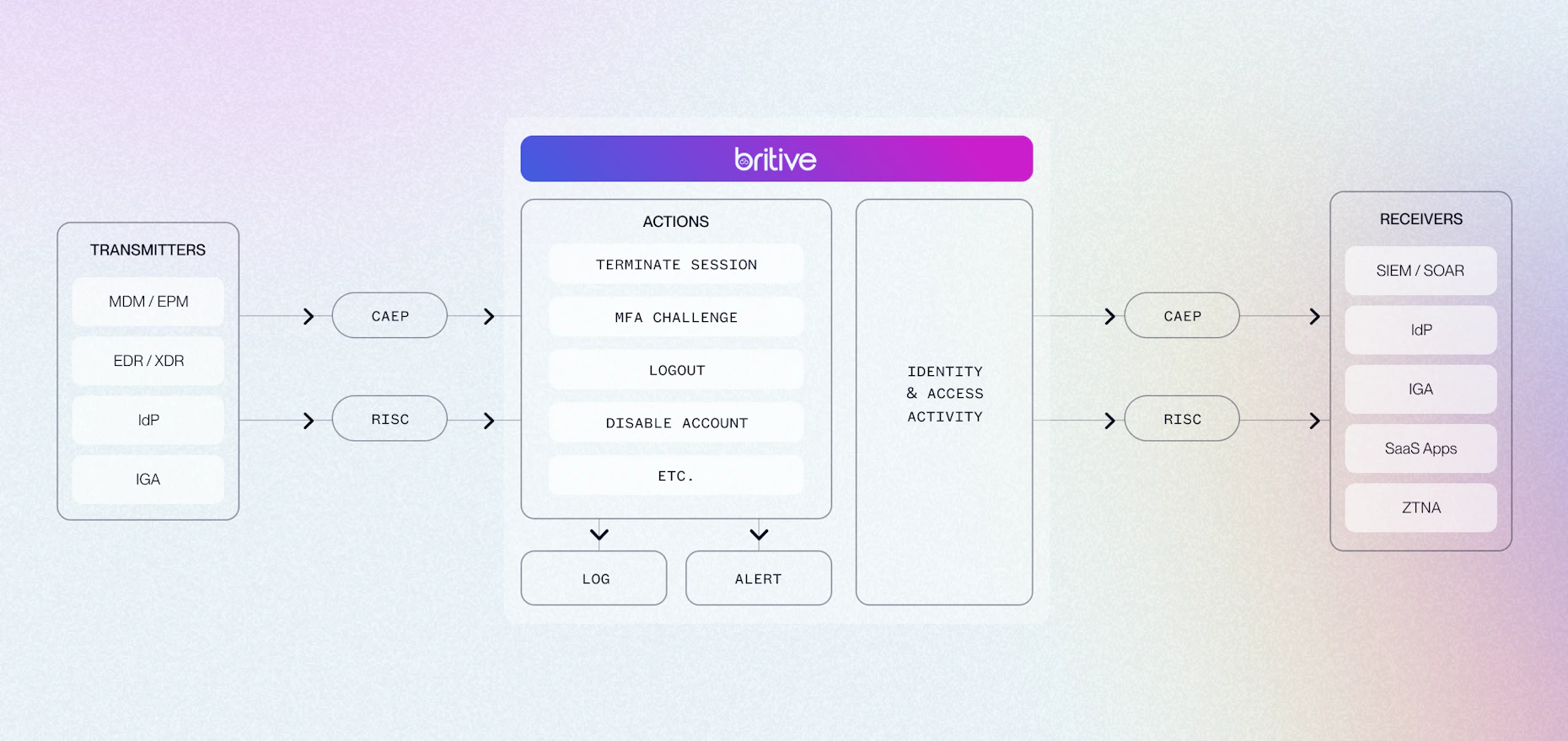
Instead of security platforms operating in silos, SSF enables them to exchange signals about critical changes in identity risk, device posture, credential status, and session health. It is split across two primary types of standardized events:
- Continuous Access Evaluation Profile (CAEP): These events are concerned with deltas or changes in the state of an identity or device. For example, if a user suddenly registers a new MFA device, or if an Endpoint Detection and Response (EDR) agent detects that an endpoint's antivirus was just disabled mid-session, a CAEP event is broadcast.
- Risk Incident Sharing and Coordination (RISC): These events are focused on specific, point-in-time risk actions. For example, if an account is disabled by an Identity Provider (IdP) due to suspected compromise, a RISC event is generated.
The framework relies on "Transmitters" (tools that broadcast the signal, like an EDR or IdP) and "Receivers" (tools that consume the signal and take action).
Using SSF to Enforce Continuous Privilege
By natively integrating SSF, Britive is moving PAM from a point-in-time check to continuous privilege enforcement. Britive acts as an SSF Receiver, capable of ingesting CAEP and RISC events from any compatible tool in your existing security stack without the need for proprietary connectors.
If a trusted transmitter, like an endpoint security agent, broadcasts a CAEP event indicating that a developer's laptop has fallen out of compliance while they are logged into an active AWS session, Britive doesn't just log the event. It takes immediate, automated action based on your configured policies.
In seconds, Britive can:
- Automatically terminate the active cloud session mid-flight.
- Force a logout across all connected applications.
- Demand step-up MFA before allowing the session to continue.
- Disable the Britive user profile entirely.
The privilege is revoked the moment risk is detected, rather than after a ticket is filled.
Bidirectional Intelligence: Sending Context to Your Stack
True Zero Trust requires a collaborative ecosystem, which is why Britive’s SSF implementation is fully bidirectional.
Britive also operates as an SSF Transmitter. Based on our deep visibility into identity and privileged access activity, Britive emits its own CAEP and RISC events back into your security ecosystem.
For example, if an identity checks out a highly privileged access profile, or if a new automated service account is provisioned, Britive broadcasts that event. Downstream tools (like your SIEM or SOAR platform) that are subscribed to Britive’s signal stream can instantly incorporate this vital access context into their own automated risk decisions.
The Next Step in Zero Trust Enforcement
Just-in-Time (JIT) access with Zero Standing Privileges (ZSP) was step one of modernizing cloud security. We proved that static credentials could be replaced with ephemeral access.
Continuous enforcement is step two. Privilege should only be held as long as the live security posture of the identity and device justifies it. By natively supporting SSF across human, non-human, and AI identities, Britive is ensuring that every active session is held strictly accountable to reality.



Britive Team
View All PostsView All Posts