

DevOps & Automation Workflows
Enable Secretless Access for DevOps, CI/CD, and Automation




Pipelines Need Privilege. They Don't Need to Keep It.
Engineering teams ship many times a day across clouds, clusters, and SaaS tools. Every pipeline, script, and workload needs privileged access to do its job, and most teams solve that with long-lived keys: stored in a vault, injected at build time, and still valid long after the job ends.
Fetching a stored secret faster doesn't remove it. A key that exists between runs can be copied from a log, a runner, or the vault itself, and service accounts quietly collect permissions nobody reviews.
Britive takes a different approach. Access is authorized at runtime, created for the job, and removed when it ends, so nothing is left standing between runs for anyone to steal.



Built forDevOps
Access That Runs Where Engineering Works
Britive gives AI coding assistants, pipelines, workloads, and engineers access through the tools they already use, under one runtime policy model. There's no portal to visit and no pipeline key to rotate.
[ 001 ]
Secretless CI/CD Through Workload Identity Federation
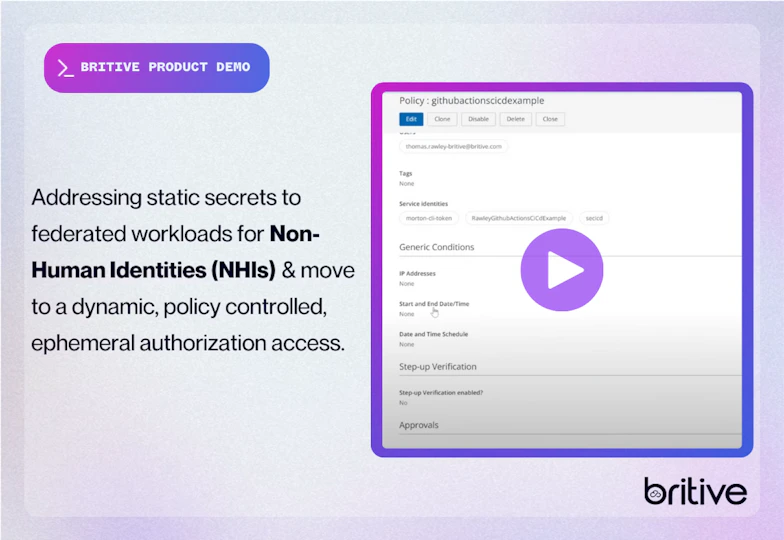
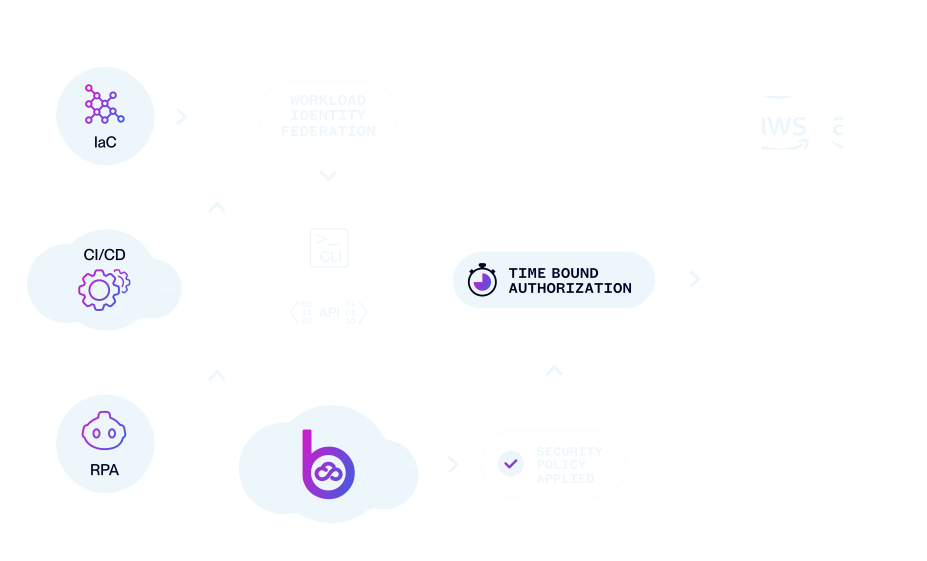
Pipelines prove who they are with their platform's own identity token, using OIDC or SPIFFE. Britive checks policy, creates a short-lived cloud identity scoped to that run, and removes it when the job ends. Works with GitHub Actions, GitLab, Bitbucket, Argo CD, Jenkins, and SpaceLift across AWS, Azure, GCP, and OCI.
[ 002 ]
PyBritive CLI for the Terminal and the Pipeline
PyBritive, Britive's open-source CLI, checks out cloud credentials, secrets, and SSH access without opening a browser, and works alongside the AWS, Azure, and GCP CLIs, kubectl, DBeaver, and MobaXterm. Every command is scriptable, so the same checkout an engineer runs by hand can run inside a pipeline.
[ 003 ]
Access Policy as Code With Terraform
Britive's Terraform provider manages applications, profiles, and policies as code, so access changes go through the same version control and peer review as infrastructure. Marqeta anchored its entire Britive deployment in Terraform, with every access policy version-controlled and peer-reviewed.
[ 004 ]
A Named Identity for Every Workload
Each pipeline, script, and workload runs as its own service identity under the same profiles and policies as people. Short-lived API tokens replace shared keys, and every action is recorded to the identity that took it, so automation never hides behind a human account.
[ 005 ]
Kubernetes Access Without Standing Cluster Admin
Engineers check out scoped access to a cluster through kubectl when they need it and lose it when the window closes, with no sidecars to deploy. When a session needs recording, kubectl exec can run through Britive Bridge so every command is captured.
[ 006 ]
Access From Chat and AI Coding Assistants
Engineers request and approve access in Slack or Microsoft Teams, or ask an AI coding assistant such as Claude Code or Codex to check it out in plain language. Approvals, one-time passcodes, and expiry apply exactly as they do in the console.
What Changes for Engineering and Security Teams
REQUEST A DEMOREQUEST A DEMO
Releases That Don't Wait on Access
Access arrives in the CLI, pipeline, or chat tool engineers already use, so a deploy or a fix never waits on a portal or a ticket queue. One scientific services leader automated access for 3,000+ developers and reached production in under three weeks.
Nothing Standing Between Runs
Pipelines carry no long-lived keys, and service accounts don't hold permissions between jobs. A credential copied from a log or a runner stops working once the job that used it ends.
One Platform, Not a Secrets Tool Plus an Access Tool
Secretless pipeline access, a vault for the secrets that can't be retired yet, and time-bound access for engineers all run under one policy model. Secrets can still sync to AWS Secrets Manager, Azure Key Vault, HashiCorp Vault, and GCP Secret Manager.
Proof for Every Checkout
Every checkout and approval, whether a person or a pipeline made it, is recorded to a named identity. Events stream to your SIEM, including Google SecOps and Datadog, so nobody rebuilds the trail from runner logs.
REQUEST A DEMOREQUEST A DEMO