

MCP Gateway
Runtime Enforcement for Britive's ARC™




Every Tool Call Decided at the Moment It Happens
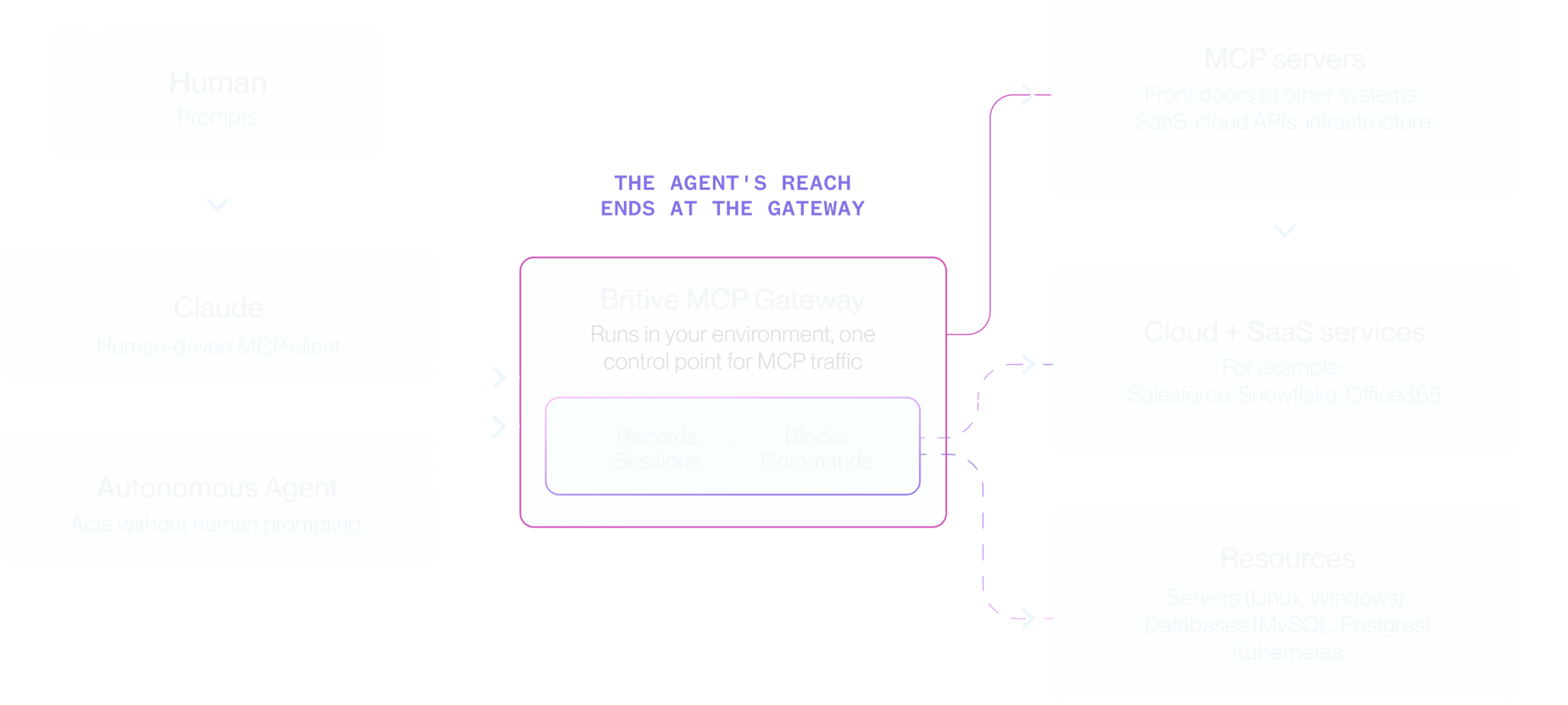
The Britive MCP Gateway sits between your MCP clients and the MCP servers they call. Deploy it inside your own network, point agents and users at it as their single MCP endpoint, and every downstream tool call is intercepted, authorized, and credentialed by Britive before it runs.
The gateway does not decide anything on its own. Every call is checked against policy on the Britive platform, the same engine that decides non-human and human access. The default is deny, and when a call needs privilege, Britive creates it for that task and removes it afterward.
Your organization registers the MCP servers it sanctions, both the remote ones your teams reach over the internet and the private ones inside your own network. Connections live on the Britive platform rather than in anyone's client, so no client ever holds a token. Claude connects to the gateway through the Britive MCP Gateway Relay extension, installed once and available across your organization, and Claude Code and Codex connect directly.



Britive MCP Gateway
Product Capabilities
The gateway is a policy enforcement point, not a standalone proxy. It carries MCP tool calls and nothing else, and it inherits the policy engine, the privilege lifecycle, and the audit stream that already govern access on the Britive platform. Here is what happens to a single call.
[ 001 ]
Only the Tools an Identity May Use
The tools the gateway publishes to an identity are exactly the tools that identity is entitled to. A server may expose sixty tools while a given identity sees ten, and every call is checked again at execution. Policy applies to individual tools or groups of them, and its members can be people, tags, service identities, or agentic identities. Seeing a tool is not permission to use it, and access you do not have is access you cannot even find.
[ 002 ]
Every Call Authorized at Runtime, Default Deny
The gateway asks the Britive platform for a decision on each call, evaluated against the identity, the tool, the arguments, the target, and the conditions of the request. If no policy explicitly allows it, the call is denied and never reaches the downstream server. Sensitive calls can wait for a person's approval through Slack, Microsoft Teams, or email.
[ 003 ]
Access Created for the Call, Not Standing on the Resource
Tools are modeled as resources with their own policies, so a tool can carry the access its work requires. Britive provisions that access two ways: by raising the agent's permissions inside the target system's own access model with no privileged credential issued, or by creating a temporary credential that did not exist before the call and does not exist after the task.
[ 004 ]
Credentials Your Agents Never Hold
The token the gateway gives an agent is only good for talking to the gateway. Downstream credentials are held by the Britive platform and handed to the gateway for a single call, so the gateway itself persists nothing and no privileged credential sits in an AI client, on a developer machine, or in a configuration file. A leaked agent token fits nothing else in your environment.
[ 005 ]
Access Enforcement Deeper Than the Tool Call
A tool call can carry a payload the MCP server passes straight to the resource behind it, such as a shell command or a database query, and the protocol itself provides no control over that content. Where configured, Britive evaluates that traffic in the path, and what is permitted comes from the checkout that created the access, so a read query runs while an insert or a table change is blocked before it reaches the database. Sessions are recorded and searchable by command.
[ 006 ]
Deployed Inside Your Network, and Fully Recorded
The gateway runs in your environment because connections have to originate inside your network going out, with nothing opened to inbound traffic. Because every call passes one point, each is attributable to a named identity and recorded as it happens. Every call in a single client session correlates under one session ID, even when that session touched several different servers, and those events flow into the platform audit stream and on to your SIEM and SOAR.
Benefits of the Britive MCP Gateway
REQUEST A DEMOREQUEST A DEMO
One Place to Control Every Sanctioned MCP Connection
Instead of tokens scattered across clients and configuration files, every MCP connection your organization sanctions runs through one enforcement point, with one policy model and one record.
Nothing Standing Behind the Call
Other gateways decide whether a call is allowed and then hand it a credential that already exists on the resource. Britive creates the access the call requires and removes it afterward, so nothing privileged is waiting between tasks.
Bypassing the Gateway Finds Nothing
A connection that goes around the gateway with a raw key reaches an identity with no privileges, and protected resources give no access without an active checkout. The honest claim is not that the gateway cannot be bypassed. It is that bypassing it gets you into an empty room.
Agents In Production Instead of Waiting
Engineering teams put agents into production without creating permanent exceptions in the enterprise access model, and without waiting in a ticket queue for access that expires anyway.
Every Call Is Answerable
When someone asks which agent did what, under whose authority, the answer is already recorded, down to the tool, the arguments, and the commands that ran.
REQUEST A DEMOREQUEST A DEMO