

Back to resources
Inside the Agentic Identity Security Category: Questions Every Buyer Should Be Asking
May 2026 / 4 min. read /
Three architectural questions every buyer should be asking now that the category exists.
Aragon Research's 2026 Technology Arc for Artificial Intelligence introduces "Agentic Identity and Security" as its own category for the first time. It sits in the Emerge phase of the curve, near the top, approaching Adopt. Categories in that position are moving out of early experimentation and toward mainstream buying.
Britive is listed in it. The more interesting question isn’t who is listed, but the “why” behind the category’s creation in the first place.
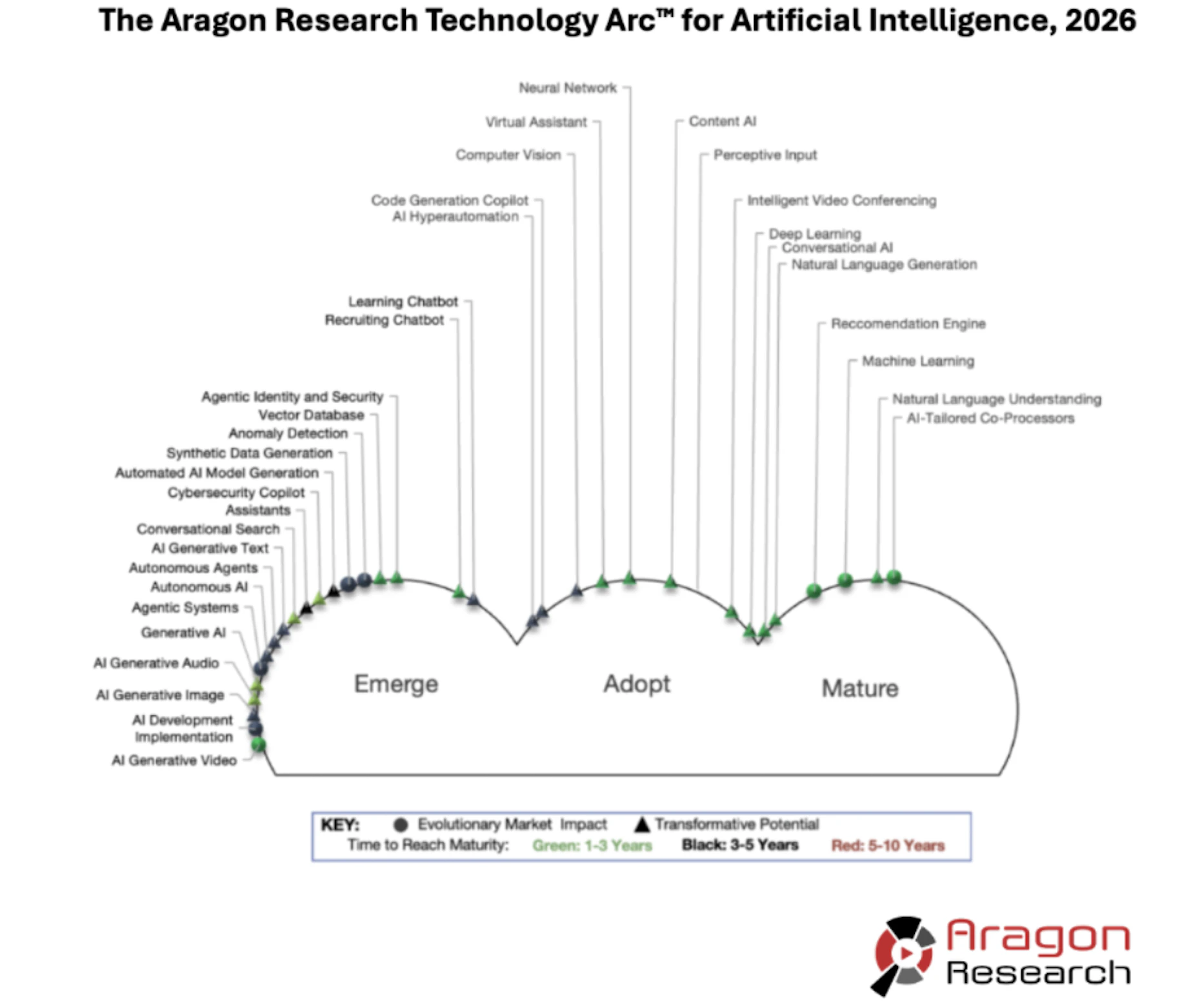
This graphic was published by Aragon Research, Inc. as part of a larger research report and should be evaluated in the context of the entire document. The Aragon Research report is available at AragonResearch.com. Aragon Research is a registered trademark and service mark of Aragon Research Inc. and/or its affiliates in the U.S. and internationally, and TECHNOLOGY ARC is a registered trademark of Aragon Research and/or its affiliates and are used herein with permission. All rights reserved. Aragon Research does not endorse vendors, or their products or services that are referenced in its research publications, and does not advise users to select those vendors that are rated the highest. Aragon Research publications consist of the opinions of Aragon Research and Advisory Services organization and should not be construed as statements of fact.
The Environment Changed, but the Access Model Did Not
Privileged access management was built for a specific kind of identity in a specific kind of environment: Human administrators logging into static infrastructure to perform predictable, infrequent actions. Centralize the credentials in a vault. Rotate it on schedule. Force the human through a session broker. Record the session.
The model worked for as long as certain environmental assumptions held true:
- Credentials are an adequate control surface.
- Privileged accounts and the actions they take are deterministic.
- Infrastructure is relatively steady and changes slowly.
Cloud and SaaS strained those assumptions. Static credentials gave way to short-lived federated tokens, permissions multiplied across providers, and sessions became less coherent as workflows moved through APIs and pipelines instead of jump boxes or specific gateways.
Agentic AI has changed the math entirely.
An AI agent is not a human admin and not a service account. It receives a goal, selects tools, reads untrusted content from the open web, and adapts at runtime. It can run in seconds, spawn sub-agents, and act on behalf of identities that may not exist for the length of the action it is about to take. A vault rotation schedule measured in days is irrelevant to a credential a workload holds for nine seconds. A quarterly access review cannot reach what runs in milliseconds.
The tools that came before were built for a different operating environment. The issue is not effort. It is architecture. The market needed a new category because the existing categories did not describe the problem buyers were actually trying to solve.
The Category is Not About "AI Agent Access Management"
Most of the vendors stepping into this space have made an understandable but incomplete bet by building a separate stack for agents.
Having a separate identity store, policy engine, and enforcement model dedicated to the AI pipeline inevitably leads to the same pattern that resulted in identity sprawl that many modern enterprises have already been moving to address.
Implementing one tool for humans, another for service accounts, and another for cloud roles leads to fragmentation and siloing that results in potential gaps in visibility and enforcement.
Agents are simply another identity type that can request access, hold privileges, act on resources. The same architectural questions that apply to human identities apply to them.
How is privilege granted? How long does it persist? What triggers revocation? What evidence remains?
The defining requirement of an Agentic Identity Security Platform is not agent-specific tooling.
It’s about having one runtime control point that enforces privileged access for human, agentic AI, and non-human identities under the same architecture, policy model, enforcement engine, and even audit trail.
One runtime control point and architecture that holds true for all identities: human, agentic AI, and non-human.
If the answer to "how do we secure access for our agents" looks fundamentally different from the answer to "how do we secure access for our admins," another silo has been added, not removed.
What the Architecture Actually Does in Four Steps
At its most basic, one runtime control point does four things, in sequence, every time an identity acts.
Discover. Before access can be enforced, the platform has to know what exists: a continuously updated inventory of every identity in the environment (human, agentic AI, and non-human), along with the permissions, accounts, and standing access paths each one holds. Discovery is a live map, not a one-time scan.
Authorize. When an identity requests to act, the platform evaluates that request in context. Who is asking, what are they trying to do, against what resource, with what surrounding signal, and what does policy say should happen right now? Authorization decides.
Enforce. Enforcement acts on the decision. Privilege is created for the specific task and only for that task, scoped to the action, bounded in time, and revocable on any signal change. When the work ends, the privilege is removed. Nothing accumulates, and nothing persists between sessions.
Prove. Every decision, grant, and revocation produces evidence at the moment it happens. The audit trail is current by architecture, not assembled quarterly. Compliance becomes a structural byproduct of the system instead of a separate process running alongside it.
Four steps, one platform, with three identity types flowing through the same decision and enforcement engine. That's what an Agentic Identity Security Platform has to deliver if the category is going to mean anything.
The Questions Worth Asking Now That the Category Exists
A category in the Emerge phase approaching Adopt is the point where architectural decisions begin to compound. Tooling chosen now sets the pattern for how human, agentic AI, and non-human access will be enforced across cloud, SaaS, on-prem, data, and pipelines for years.
The Tech Arc is useful as a market signal. What it doesn’t do is answer the harder question: what does the buyer's organization actually need from a platform in this space?
Three questions cut through most of the noise when evaluating anything that claims a place in this category.
- Can the access model serve human, agentic AI, and non-human identities under the same architecture? If the answer involves separate stacks for each identity type, the same fragmentation that produced today's identity sprawl is being rebuilt, one category at a time. The defining requirement of this category is one runtime control point across all three.
- Does privilege exist between sessions? This is the test that separates runtime enforcement from credential rotation. If a credential, role, or token sits available between uses, that is the surface an attacker reuses after compromise. The shift the category requires is from protecting credentials to creating privilege only when work needs it and removing it when work ends.
- Is the audit trail a result of the architecture, or a quarterly project? Manual evidence reconstruction is a remnant of a system where access is managed by one tool and oversight is managed by another. When authorization decides and enforcement acts at the same control point, every privileged action produces evidence the moment it happens. The trail is current because the architecture makes it current.
The Architectural Shift the Category Requires
The reason a new category had to appear on the Technology Arc is not that AI is novel. It's that the previous way of granting and enforcing privileged access can't operate at the speed of what is now asking for it.
Humans act in minutes, while machines and agents can act in a matter of milliseconds. The control plane that enforces access for all three must operate at speed and scale.
The category will mature. Vendors will enter it, refine their answers, and adjust their architectures. The architectural test will not change: one runtime control point, human, agentic AI, and non-human identities under the same architecture, four steps in sequence, no credential left standing between sessions.
Privilege should not exist before work starts. It should not survive after work ends.



Britive Team
View All PostsView All Posts