

Back to resources
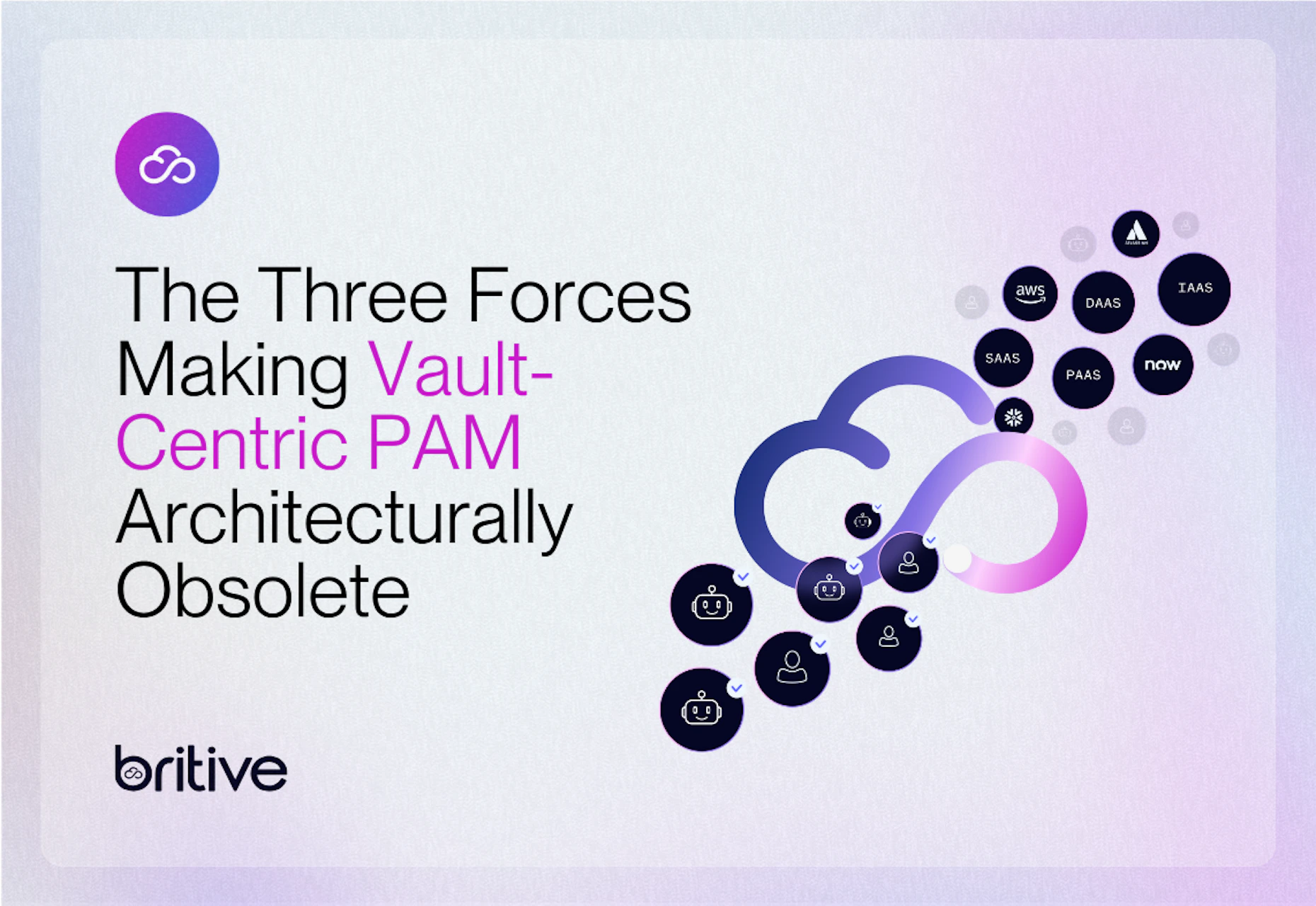
The Three Forces Making Vault-Centric PAM Architecturally Obsolete
May 2026 / 7 min. read /
Convergence, Not Single Failure
IAM strategy rarely turns on a single failure. It turns on convergence. The architectures that quietly carry an organization for a decade tend to break in the same way: not from one pressure, but from three or four arriving in the same eighteen-month window. The leaders who see the convergence early define the response. Everyone else inherits it.
Over the past three years, the ground has shifted entirely underneath traditional PAM. A classic vault might survive any one of these infrastructure changes in isolation, but together, they hit an absolute architectural ceiling.
Let’s be honest about where this leaves us: for anyone running a multi-year IAM strategy, moving past the vault isn't a roadmap item; it’s an inevitability. If your security model still relies on storing secrets rather than eliminating them, you are architecting for a past that cloud and AI have already erased.
The only real question left is whether you own this migration today on your own strategic terms, or let an auditor hand you the timeline after your next failed review.
What the Vault Was Never Built For
The first force is the density of cloud and SaaS administration. The control surface has migrated from on-premises servers to cloud control planes, where admin actions are API-driven, federated, and span hundreds of services per tenant. The vault model assumes a small population of high-value targets with well-understood access paths.
Cloud admin density inverts that assumption: thousands of potential admin actions, dozens of identity providers, and access paths the vault cannot reach without per-target integration work that never catches up to the cloud release cadence. The vault governs what it integrates with. Everything else is governed by something else, or by nothing.
The second force is workload ephemerality. The vault's rotation engine was designed for credentials with lifecycles measured in months. Modern workloads have lifecycles measured in seconds. Rotating a credential every 30 days is not a security control when the workload holding the credential lives for 90 seconds.
The mismatch has produced a generation of static workload credentials the vault does not manage and that the IAM team has limited visibility into. Most organizations have responded by tolerating the gap. The gap is not closing on its own.
The third force is agentic AI. Autonomous agents calling tools and APIs on behalf of users will multiply the non-human identity population by an order of magnitude or more within the next 24 months. Vaulting a credential per agent is not architecturally viable, and the bolt-on patterns being marketed as "agent vaulting" are extending the original architectural mistake at higher volume.
The control model has to evaluate each tool call, not each session. That is not a capability the vault was built for, and it is not a capability that gets added through a feature release.
Any one of these forces would be a hard problem for the vault model to solve. The three arriving together is not a problem the vault model gets to solve at all.
Three Signals Already Visible in Your Environment
For IAM leaders looking for operational signals that these forces are compounding in their environment, three are reliable.
First, look at how much of your privileged access goes through your PAM platform. In most cloud-heavy organizations, the honest answer is well under half. The rest is happening through AWS IAM Identity Center, Azure PIM, GCP IAM, federated SSO with assumed roles, workload identity federation, and whichever secrets managers each application team adopted before anyone could stop them. If your vault has quietly become the documentation surface while the actual control surface lives somewhere else, that is the first signal. And it is not a signal that gets better on its own.
Second, look at how your service account rotation cadence has changed over the past two years. The policy on the intranet probably still says 30 or 60 days. The reality, for any team operating cloud workloads at scale, is that rotation windows have been quietly extended, exception lists have grown, and a handful of accounts have been carved out entirely because the pipelines break otherwise. That is not rotation hygiene. That is risk reduction traded for uptime, with the exception list doing the governing the engine was supposed to do. If the auditor asks the right question, the policy documented will not save you.
Third, look at who is in the room when your application teams talk about agentic AI access. If the answer is "not us," the architectural decisions about agentic identity are already being made. They are being made by the team shipping the agent, with whatever credential pattern was easiest to wire up. That is the leading indicator of whether IAM is shaping the next architecture or inheriting it, and the lag is measured in months rather than years. By the time the IAM team is invited in, the pattern is already in production, the budget is already spent, and the conversation is no longer about architecture. It is about clean up.
Runtime ZSP Is the Architectural Target
There is a window of about 12 to 24 months for IAM leaders to shape the response to these three forces as a single, coherent strategy. After that, the architecture gets decided by whatever the application teams and cloud platforms have already built without you. Catching up to that is more expensive, harder to defend, and harder to audit than getting ahead of it.
Getting ahead of it starts with naming the target. Runtime Zero Standing Privileges is the model that handles all three forces. It removes the standing credential as the thing you control. It shortens credential lifetimes to match how long workloads actually live. It evaluates policy at each tool call, which is what agentic identity actually needs. It is not a feature you add to the vault. It is a different architecture. Treating it as a vault upgrade is how organizations miss the window.
The Choice Is Already in Front of You
The three forces aren’t coming: they're already here. The vault is already managing less of your privileged access than it did two years ago, your rotation cadence is already slipping, and your application teams are already building agentic workflows.
The only open question is whether your 2026 plan names the shift and gets ahead of it, or whether 2028 finds you explaining to an auditor why your architecture lagged the business by two full cycles. A runtime, zero standing privileges model is where privileged access is going either way. The only variable is whether you design it or inherit it.
So if you traced where privileged action actually happens in your environment tomorrow morning, would the vault still be at the center of it?