


BeyondTrust maps the risk. Britive removes it.
BeyondTrust's attack path analysis surfaces overprivileged IAM roles, maps how an attacker could chain them, and flags the highest-risk standing permissions in your environment. What it doesn't do is eliminate them. The risk is documented. The standing access stays. Britive replaces standing permissions with runtime-provisioned, auto-revoked access, so the attack paths BeyondTrust identifies can't recur because the permissions no longer exist between sessions.
See what's still standing after BeyondTrust flagged it →







Detection without remediation. And what closes the gap.
BeyondTrust identifies overprivileged roles and maps attack paths. When a risk is flagged, their automated remediation typically relies on firing webhooks to rotate static passwords in a vault or sending alerts to an ITSM ticket. It is a reactive patch to a standing risk.
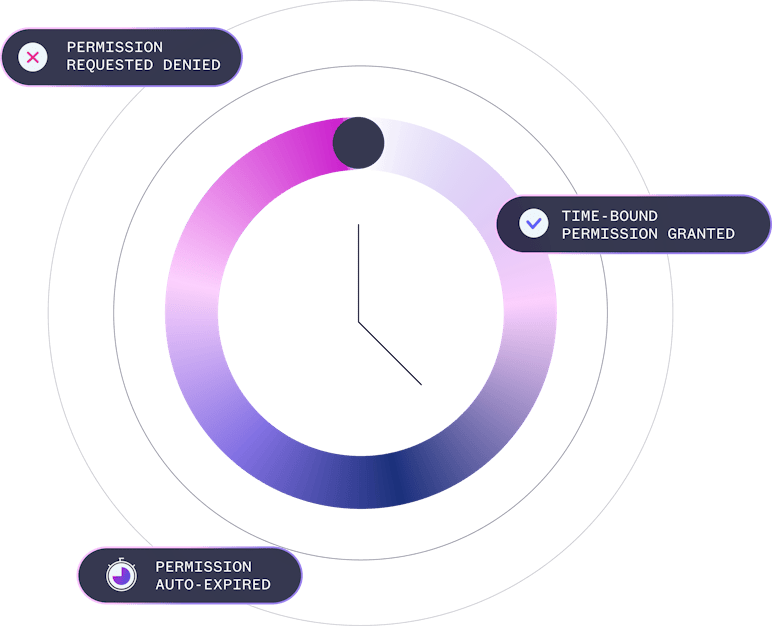
Britive doesn't just flag standing permissions; it eliminates them architecturally. Permissions are minted at request time via native APIs and automatically revoked. If a risk is detected mid-session, Britive's continuous SSF enforcement instantly destroys the active token. No webhooks or password rotations required.

With Britive Every Privileged Session Begins from Zero Standing Access
Built to Scale
BeyondTrust can show you identity risks across your environment, but actually securing those diverse identities forces you back into their legacy architecture: checking credentials out of a vault. You cannot secure high-velocity NHI workloads or non-deterministic Agentic AI by locking static keys in a digital box. Britive governs Human, AI, and Machine identities under one unified policy engine, minting ephemeral access directly at the API layer. No agents, no heavy session proxies, and zero standing risk.
Lower Cost by Design
BeyondTrust's remediation workflow requires manual action to close each flagged risk, a cycle that runs continuously as new standing permissions accumulate. Britive eliminates the cycle. JIT by architecture means nothing accumulates to review. Fewer dedicated PAM administrators. No quarterly access certification scramble. One platform replaces fragmented tooling.
Risk Reduced at the Privilege Layer
BeyondTrust surfaces risk. Britive removes it. Every privileged session begins from zero standing access and ends at zero. Cloud IAM entitlements, SaaS platform permissions, CI/CD pipeline credentials, NHI access, and AI agent tool calls are all governed under one ZSP policy. SSF/CAEP continuous enforcement means a non-compliant device mid-session terminates access immediately.
Closing the Remediation Loop
Step 1: Identify what's standing and ungoverned.
Start with the permissions BeyondTrust has already flagged as highest-risk: cloud IAM roles with overprivileged access, service accounts with broad entitlements, pipeline credentials with standing access. Britive's free cloud access assessment maps what's currently ungoverned across AWS, Azure, and GCP, with no agents and no commitment.
Step 2: Replace standing permissions with JIT profiles.
For every flagged standing permission, Britive creates a JIT access profile. Engineers, pipelines, and AI agents request the profile when they need access. Britive provisions scoped, time-bound access via native cloud APIs and revokes it automatically when the session ends. The highlighted attack path shouldn't exist between sessions because the standing permission is gone.
Step 3: Continuous enforcement, not periodic review.
Britive's SSF/CAEP integration means enforcement is continuous, not just a point-in-time. If a device goes non-compliant mid-session, access is terminated immediately. Every access event, policy evaluation, and revocation is logged automatically. Compliance evidence for SOC 2 Type II, PCI DSS, NYDFS, HIPAA, DORA, and other frameworks is always kept current.
BeyondTrust vs. Britive
Detection and remediation — two different problems.
BeyondTrust vs. Britive
Detection and remediation — two different problems.
BeyondTrust
Britive
Core Value
Privilege escalation path analysis and risk visibility.
Elimination of standing permissions. JIT access as the architectural default.
Remediation Model
Flags the risk. Remediation occurs with rotating static passwords after an anomaly is detected.
Eliminates the risk. JIT model replaces standing access so the pattern cannot recur.
Cloud Enforcement
Detects risks across cloud entitlements, but access enforcement defaults back to checking out vaulted credentials.
Native JIT for AWS IAM, Azure RBAC, GCP bindings, OCI — with automatic policy-driven revocation.
SaaS Coverage
No native SaaS access governance.
Native JIT for Snowflake, Salesforce, Atlassian, ServiceNow, and 100+ more.
Non-Human Identities
Primarily handles NHIs by storing static API keys and service accounts in the vault, forcing pipelines to pause and execute a checkout.
First-class. OIDC federation, JIT per pipeline run, full NHI lifecycle management.
Agentic AI
Uses anomaly detection to flag risky AI behavior after the connection has been made and the access event has occurred.
Distinct identity class. MCP Gateway. Human-in-the-loop. SPIFFE federation. Full audit trail.
Enforcement Model
Detections are generated from logs, which trigger alerts for human review or automated ITSM ticketing.
SSF/CAEP continuous enforcement — non-compliant device mid-session terminates immediately.
Audit Trail
Risk and session event logging.
Continuous access governance audit trail — every provisioning, policy evaluation, revocation.
Have your flagged access risks actually been addressed?
Visibility into potential attack paths is only the beginning; ensure that the underlying access risk has successfully been resolved.
Schedule a personalized demo →
FAQ
What do you mean by “ephemeral JIT access”?
'%20stroke-width='2'/%3e%3cdefs%3e%3clinearGradient%20id='paint0_linear_1063_5522'%20x1='0.871795'%20y1='1.23504'%20x2='20.1122'%20y2='10.6379'%20gradientUnits='userSpaceOnUse'%3e%3cstop%20stop-color='%23CA1ECC'/%3e%3cstop%20offset='1'%20stop-color='%233E5DE0'/%3e%3c/linearGradient%3e%3c/defs%3e%3c/svg%3e)
Ephemeral JIT means the privilege itself does not exist until it is requested. Access is created at runtime, scoped to the task, and removed when the task ends. Nothing stands by before or after.
How is this different from traditional JIT access?
Traditional JIT limits when a credential can be used. The privileged role still exists. Britive limits when privilege exists. If the work is not happening, the privilege is not there.
How does this work with Agentic AI and autonomous workflows?
Agentic AI needs access that is dynamic, task-scoped, and short-lived. Britive treats AI agents as first-class identities and applies the same access model used for humans and automation. Privilege is created at runtime for a specific action, scoped by policy, and removed immediately after. Agents never hold standing access or long-lived credentials, even as they act autonomously.
Does this work for machine identities and automation?
Yes. The same access model and policies apply to pipelines, service accounts, and automated workflows.
Can Britive integrate with ___?
Yes! Britive is API-first and integration-friendly, allowing seamless out-of-the-box integrations with cloud infrastructure providers (AWS, GCP, Azure, etc.), SSO & Identity Providers (Okta, Microsoft Entra ID / Azure AD, Ping Identity), SIEM & Logging Tools (Splunk, Datadog, etc.) and DevOps & CI/CD Pipelines (Terraform, GitHub Actions, Kubernetes, etc.).
You can find a starting list of our integrations here.
Does Britive allow the import of privileged accounts for other systems?
Yes, Britive offers the ability to import privileged accounts from other systems for seamless integration and centralized management. Privileged accounts from cloud platforms like AWS, Azure, and Google Cloud, as well as on-premises systems, can be imported into Britive. Automated discovery simplifies the process, identifying existing accounts for streamlined integration.
Does the Britive solution offer any "break glass" access?
Yes, Britive offers "break glass" access capabilities, including support for managing emergency access to critical accounts such as AWS root accounts. This ensures operational continuity and secure access during emergencies. This includes strict access policies, logging, and enforcement of strong authentication methods for enhanced security.
Break glass access is also strictly monitored and governed by approval workflows, ensuring that usage is authorized and fully auditable.
Does Britive support session recording?
Yes, Britive's session recording capability is lightweight and easy to deploy for selective monitoring of RDP and SSH sessions.
Do I still need a vault?
Britive offers vaults where static secrets are unavoidable. For cloud and SaaS privileged access, Britive issues ephemeral privileges directly and does not depend on stored admin credentials.
What about audits and compliance?
Every request, decision, and expiration is logged. You can see who had access, to what, and for how long without reconstruction.
Case studies
Britive in the Real World
001
002
003
001
002
003




Financial Services Company Streamlines Access Management
Forbes Saves Costs & Removes Standing Privileges to Align with Zero Trust Security
Fortune 500 Retail Giant Eliminates Standing Access Across Growing Cloud Footprint
7000+
54k+
67k+
30,000+
400+
< 30 min
Privileged human identities managed
Static Privileges Eliminated
Static privileges eliminated across all cloud providers
Non-human identities access managed
Identity profiles managed in GCP
Total on and off-boarding time, reduced from 3 days