

Back to resources
What AI Agent Governance Frameworks Leave Out: When the Privilege Ends
September 2026 / 8 min. read /
You Can See Your AI Agents, But Can You Stop Them?
Not long ago, most security teams couldn’t answer a basic question about the AI agents running inside their environment: how many there were, who owned them, and what they could reach. That has changed fast. Discovery tooling has matured, the cloud providers exposed their agent platforms, and an inventory is something that security teams can reliably produce.
Inventory turned out to be the easy half. Practitioners have summarized their conversations and experiences: “We can see the agents; we just can’t stop them.”
Organizations can find, name, and document AI agents, but on its own, this isn’t enough to secure them. As the ARISE report from Software Analyst Cyber Research notes, many vendors can discover agents and display their activity, but “fewer can demonstrate that those signals change the outcome of a live action.” When an agent does something nobody intended with “valid” credentials, visibility and documentation won’t be much help in preventing the action or mitigating damage.
From “What Can This Agent Do?” to “Should This Action Happen Right Now?”
Most AI agent governance frameworks answer the question "what is this agent allowed to do." It’s a reasonable question that organizations need to be able to answer.
But it isn’t the question a security team is under pressure to answer right now. That question is narrower and much harder to ascertain: should this specific action be allowed, right now?
The gap between those two questions is where most agentic AI programs are stuck. The clearest way to find it is to look at what most governance frameworks require, and what each of those requirements takes for granted.
The Six Requirements of a Typical AI Agent Governance Framework
Nearly every AI agent governance framework in circulation, whether it comes from a vendor, a standards body, or an internal architecture team, produces some version of these six requirements.
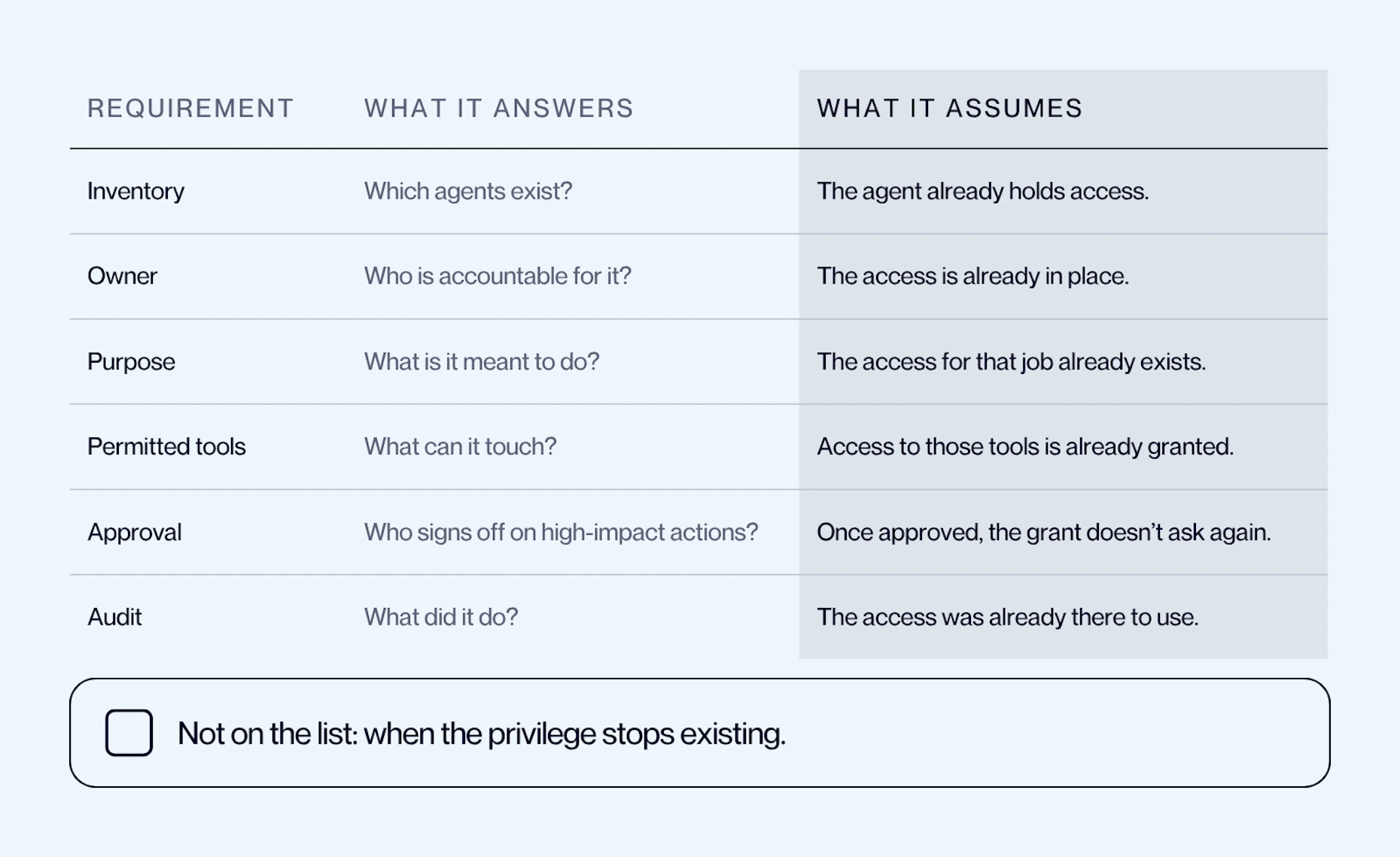
- Inventory. Every agent operating in the environment is identified and registered. You can't govern what you haven’t found, and agents spawned from a developer’s workflow are the kinds of agents that often fly under the radar.
- Owner. Every agent has a named human accountable for it. When something goes wrong, there is a person to ask instead of a team to page.
- Purpose. Every agent has a documented job. Purpose is what makes overreach legible later, because "the agent queried the payroll database" only reads as a problem once someone has written down that the agent exists to triage support tickets.
- Permitted tools. Every agent has a defined set of tools, systems, and data it may touch. This is the line most frameworks spend the most words on, and it's the requirement that most closely resembles traditional least privilege.
- Approval. High-impact actions require a human to sign off. Nobody is comfortable with fully autonomous remediation yet, and most enterprises keep agent action inside existing change control for exactly this reason.
- Audit. Everything the agent did is logged, retained, and reviewable.
An organization that meets all six knows which agents it runs, who answers for each one, what each is meant to do, and what each has done. The issue is what all six take for granted.
Every Governance Requirement Assumes the Access Already Exists.
Inventory records that an agent exists, along with the access it already has. An owner is assigned to access that already exists. Purpose documents the intent behind access that already exists. Permitted tools set the scope of access that already exists. Approval gates the first use of that access, and often only the first, because once an agent is approved for a category of work, the grant behind it doesn't ask again. Audit tells you what was done with that access after the fact.
Six requirements, all with one shared assumption: the privilege is there the whole time. It exists before the agent starts working, exists between one task and the next, and continues to exist when the agent isn't doing any work at all.
This isn't a fringe observation. The Cloud Security Alliance made a version of the same argument in its April 2026 research note on the AI agent governance gap, naming standing privilege proliferation as one of three execution-phase failures in current frameworks and describing agents that receive permissions matching the human employees who provisioned them, rather than permissions scoped to the task at hand.
An agent typically inherits its authority from the person who launched it. If the agent inherits that person's credentials, it inherits that person's blast radius, and each requirement above documents that blast radius without making it any smaller.
Why Governance Frameworks Weren’t Built for AI Agents
This is an inheritance problem that runs in two directions.
The agent inherits its authority from the human who launched it. And the governance model inherits its assumptions from an earlier generation of software: applications that ran on a schedule and people who worked in finite, definable sessions. In both cases, describing access up front and reviewing it afterward was a sound strategy, because the gap between the description and the behavior was small and slow.
An AI agent closes that gap to nothing. It decides its own path at runtime, chains tool calls that nobody sequenced in advance, and acts in seconds rather than hours. The risk is created while the chain is still unfolding, which is precisely the window that a pre-deployment review and a post-incident log both miss. Breakout time, the metric security teams have used for years to describe how fast an intruder moves, starts to lose its meaning when the actor moves at machine speed and carries valid credentials the whole way.
The frameworks aren't necessarily wrong; they were written for a world where authority sits still, and they're now being applied to agents that don't.
The Missing Security Requirement: Eliminating Standing Access
One requirement is missing from the checklist, and it's the only one that enforces itself.
When does the privilege stop existing?
Every other requirement on the list is a description that a human has to maintain, review, and act on. This one is different, because a grant that ends on its own doesn't depend on anybody noticing. It's the difference between governance as documentation and governance as a control.
It's also the fastest way to test any agentic access model, including one you already own.
Ask yourself: what exists in the target system between tasks? If the answer is a role, a credential, a token, or a session that survives until someone revokes it, then the governance program describes the risk accurately but doesn't reduce it. If the answer is an identity with no privileges attached, the risk isn't being managed; it doesn't exist.
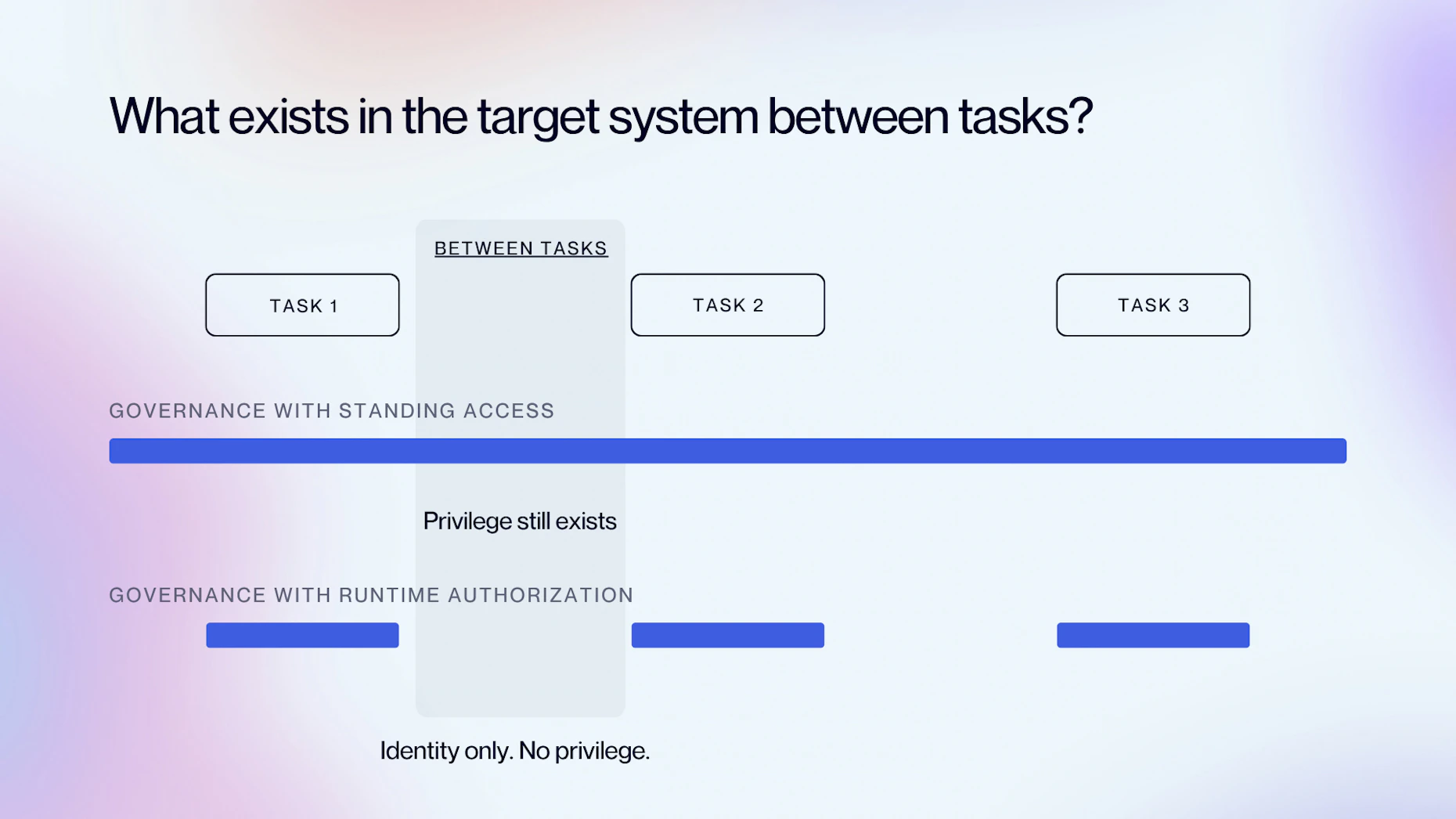
Add this requirement to your checklist and the other six get easier to meet, because you're no longer documenting a standing grant. You're documenting the conditions under which one is briefly created.
What Zero Standing Access Looks Like in Action with Runtime Authorization
This is the architecture Britive was built on, and it's why we talk about authorization as something that happens at runtime rather than something decided in advance.
Privilege is created the moment an authorized action requires it, inside the target system's own access model, and removed when the work is done. Between tasks, the agent holds only an identity with nothing attached to it.
Deciding per action instead of once per session creates two moments that a session-based model structurally can't have. A person can approve sensitive access before that access exists, with the action blocked until the approval is given. And a command can be blocked after access was already approved, because where Britive sits in the connection path to the resource, access enforcement continues below the tool call, down to individual commands and queries, before they reach the resource. An agent authorized to read from a database can still be stopped from performing a destructive action against it.
Because the decision is made per action, signals from the security tools you already run can revoke access while a task is still running, rather than waiting for the next review cycle.
The record that comes out the other side isn't only a list of what happened. It connects the identity that delegated the work, the agent that performed it, the action taken, and the decision that permitted it. Logs record outcomes. Proof requires the decision behind the outcome, which is the thing governance frameworks ask for and rarely get.
Britive ARC™ is how this model extends to AI agents, on the same policy engine already governing non-human identities and people.
Don’t Sacrifice Speed for Security
The reason this matters isn't fear. It's that agent projects stall in pilots when the only two options on the table are granting broad standing authority or waiting another quarter.
Security teams don't have to choose between those. An agent with an identity and no standing privilege can be given real authority to do real work, because every meaningful action becomes a decision that's made, enforced, and recorded at the moment it happens, rather than a permission granted once and hoped about afterward.
Governance tells you what your agents are allowed to do. Decide when their privilege ends, and you control what they do, every time they try.



Britive Team
View All PostsView All Posts