

Back to resources
Zero Trust and Zero Standing Privileges: Why Network Control Is Only Half the Battle
July 2026 / 5 min. read /
Over the last decade, Zero Trust Architecture (ZTA) has reshaped how modern enterprises handle identity and network perimeters. Built on the core axiom of “never trust, always verify,” Zero Trust dismantled the outdated concept of a trusted corporate network.
Yet as enterprises mature their Zero Trust strategies across complex cloud environments, multi-cloud workloads, and autonomous AI pipelines, many discover a glaring architectural hole. Zero Trust secures the path to the resource, but it does not control what an identity can do once it arrives.
To close that gap, organizations must pair Zero Trust network controls with Zero Standing Privileges (ZSP). Never trust, always verify, and never leave anything standing.
What Zero Trust Solves (And Where It Stops)
At its core, Zero Trust operates at the network and dynamic access layer. When a user, service account, or autonomous agent attempts to connect to an application, database, or cloud console, Zero Trust evaluates contextual signals such as device health, IP location, identity validity, and posture.
Once evaluated, it establishes a secure, encrypted channel directly to that specific resource, replacing broad, static network access with precise, micro-segmented connectivity.
But once an identity passes through that secure channel, Zero Trust's job is done.
If that user or workload holds standing administrative rights, such as persistent AWS IAM policies, static broad roles, or long-lived database credentials, the secure connection simply provides a safe highway to excessive, unmonitored power.
Zero Trust decides: can this identity reach the resource?
Runtime authorization must decide: what can this identity do once inside, and how long should those rights exist?
Here is the uncomfortable math. Industry research consistently finds that the vast majority of granted cloud permissions go unused. The access attackers exploit is the access nobody is using. A secure channel to a standing admin role just means the attacker travels safely to the blast radius.
Enter Zero Standing Privileges
Where Zero Trust controls connectivity, Zero Standing Privileges eliminates static, persistent power.
The principle is straightforward: privileges should not exist at rest. Instead of leaving static admin roles, broad service accounts, or persistent cloud permissions scattered across your infrastructure, ZSP ensures privileges are minted only at the moment of execution and revoked automatically the moment the task completes.
There is a second shift hiding inside that model. Zero Trust evaluates the context of a connection. Runtime authorization evaluates the intent of a request: who is asking, on whose behalf, for what task, at what scope, for how long. The access intent, not just the identity, becomes the thing you authorize. Standing access is access with no intent attached, which is precisely why it is what attackers use.
By applying dynamic, runtime authorization to privilege, ZSP addresses the fatal flaw of persistent credentials:
- Shrinking the attack surface. If no standing privileges exist, a compromised identity yields zero standing admin rights to exploit.
- Securing non-human identities and AI. Autonomous agents and workloads do not simply log in; they act, invoking tools and executing workflows. ZSP ensures they receive strictly task-scoped, ephemeral permissions instead of broad, permanent administrative access.
- Eliminating lateral movement. Without persistent roles, a compromised session finds no standing paths to pivot across cloud accounts, workloads, or databases.
The Power of Pairing Zero Trust with Zero Standing Privileges
Combine Zero Trust network controls with Zero Standing Privileges and you get a complete, defense-in-depth model:
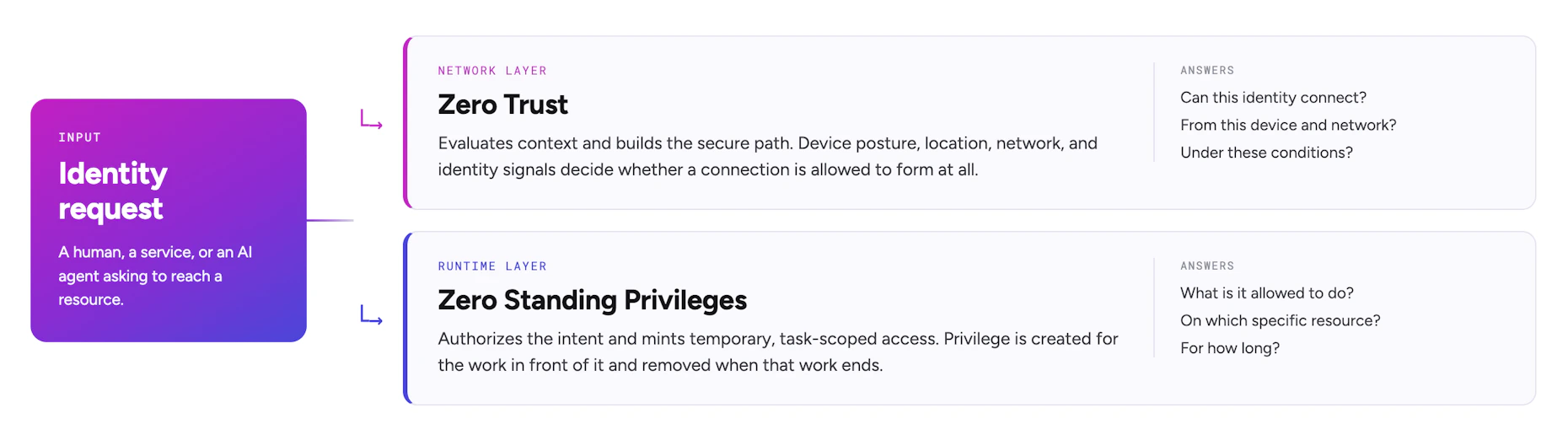
At the network layer, Zero Trust continuously evaluates the requesting identity, device, and context to establish a secure, isolated pathway to the target resource.
At the authorization layer, ZSP ensures the identity holds zero standing access to that target. Authorization decides, enforcement acts: just-in-time, ephemeral permissions scoped precisely to the immediate task.
When the work is finished, the privilege disappears and the connection closes. Nothing is left standing for an attacker to exploit. This is the sense in which zero standing privilege clears the way for Zero Trust: the model stops being a network posture and becomes something enforced at the point of action.
Worth noting where this heads next. Zero Trust already treats connection context as something to evaluate continuously rather than once. The same logic applies to privilege, where continuous authorization keeps reassessing an active session as risk changes instead of trusting the decision made at the moment of the grant.
Moving Beyond Static Controls
Securing modern cloud estates, agentic AI, and hybrid infrastructure requires moving beyond static vaults and network-only perimeters. Zero Trust secures the journey. Zero Standing Privileges secures the destination.
The distinction matters in practice, because not every approach labeled just-in-time actually eliminates standing access. Gating the checkout of a credential that already exists leaves the underlying privilege in place. Removing it is what produces zero standing privilege.
By unifying dynamic network access with runtime privilege enforcement, enterprises get the posture both models promise but neither delivers alone: full visibility into privileged activity, no persistent attack surface, and engineering velocity that does not have to be traded away for control.
Ready to see what zero standing privileges looks like in your environment? Explore how Britive applies runtime authorization across human, non-human, and agentic AI identities, or map your own phased path to ZSP with our team.



Britive Team
View All PostsView All Posts